Author: correllcoaching

Wake Up That Idea That’s Been in Your Head for Years

Published in the Independence Daily Reporter Mach 8, 2017

Many, many people tell me they’ve had an idea for a new product in their head for years. Most have put the idea to sleep, thinking it’s too expensive or too time consuming to bring the idea to life, prototype it and bring it to market. As recently as five years ago, that may have been true, but today all is changing and it’s time to wake up that idea and bring it to life at Fab Lab ICC.

Nearly two years ago, in April of 2015, we met with for the first time Tim Voegeli from a new business in Wichita called Tubeless Solutions. He’d been working with the Kansas Small Business Development Center (KSBDC) and Kansas Polymer Research Center in Pittsburg. He had an idea, which he wasn’t putting to sleep, about a new kind of bicycle rim clip that would be a great help for cycle enthusiasts in changing their own bicycle tires. Tim needed a prototype. The Polymer Research Center is not set up to do prototypes. Tim told us there was no one in Wichita that could help him with 3D prototyping. Tom Byler at KSBDC suggested he contact us at Fab Lab ICC to see if our 3D printing capability could help.

Tim joined Fab Lab ICC as an individual member and we helped him set up his first 3D print from a digital drawing his engineer, Byron Loibl provided. There was some tweaking and another model print, then another and another. One time while Tim was in the lab, he called Byron, back in Wichita to make a change. Byron emailed the new file and we started the new print job before Tim left to go home. From the seventh iteration of the design, we helped Tim print 50 sets of the clips to distribute to customer prospects and bicycle dealers so he could get direct feedback from actual customers before moving on to mass production  All this happened in just 5-weeks from Tim’s first visit to having 50 working prototype sets in his hands. His total bill with Fab Lab ICC was about $1,300. This included his membership, the 3D printing and some banners he printed for his booth displays. We helped Tim produce a professional video to use in his Kickstarter campaign. Just a few years ago, the time to prototype would be measured in months or years instead of weeks and the cost in tens of thousands of dollars instead of hundreds of dollars. Thus, Tim demonstrates the disruption in the traditional process of bringing new products to market.

It’s time to wake up that idea you’ve put back to sleep for years. Maybe it’s an improved tool you use every day, a new Internet game or something that hasn’t even been invented yet. The Fab Labs and maker spaces popping up all over the world can help you bring your ideas to life and the Internet makes taking your products to market easier than any other time in history. We hope you’ll choose Fab Lab ICC to help you wake up those ideas. We combine entrepreneurship with the Fab Lab experience in a way that’s still rare among the other Fab Labs and maker spaces. We’d love to be a part of your journey.

Jim Correll is the director at Fab Lab ICC at Independence Community College. He can be reached at (620) 252-5349 or by email at jcorrell@indycc.edu.IMG_VoegeliClipsOpt

95 Year Old Tragedy Yields Entrepreneurial Lessons for Today

Published in the Independence Daily Reporter, June 8, 2016

“History is a great teacher, but you have to go to class.”  — Clifton Taulbert, International speaker and Pulitzer nominated author.

Every time I hear Clifton speak, I’m reminded of the great power he has to embrace and inspire his audience.  Today, many of his themes are about entrepreneurial mindset and how that kind of thinking can be used to build stronger communities.  We’ve brought Clifton to speak in Montgomery County three times, starting in April of 2013.  He wows us every time.

On the campus of Tulsa University, Clifton took his keynote audience to class last Saturday at a commemoration of the 95th anniversary of the Tulsa race riot in 1921, the deadliest riot in American history during which hundreds of African American citizens were killed and 37 square blocks were burned to the ground.  The area, known as “Black Wall Street” was the Greenwood district north of downtown Tulsa.  He talked of much more than the tragedy and in that “rest of the story” lies the lessons from which we can benefit today.

In the years after the devastation of the Civil War, from 1871 through 1921, freed blacks from all over the south headed toward Nicodemus, Kansas, a new black community.  By the early 20th century, many of them began staying in Tulsa in an area that became known as Greenwood.  Eventually, there was more black intellectual and financial capital in Greenwood than anywhere else in the country.  “Black Wall Street” in Tulsa, became the “crown jewel” of black communities; it flourished.  Just after Decoration Day (now known as Memorial Day) celebrations, on May 31 and June 1, 1921 the unexpected happened and it was all “Black Wall Street” was gone.

Clifton’s lesson, however, focused on what phenomena had made “Black Wall Street” so great in the first place; imagination.  (Today, we would call it entrepreneurial thinking, but of course, we had yet to steal that term from the French.)  Imagination was about the power of thought and that through all the years of slavery “No one can incarcerate my imagination.”  The people coming to Greenwood were dreamers.  Without regard to exact plans or budgets or lack of public financing, they sat around dreaming “What can we build next?” Even the tragedy didn’t kill their imagination.  Within a decade of the devastation, things were rebuilt, stronger than ever.

So, the lesson for us is to use more imagination and power of thought to get things done, in our businesses, our communities and in our families.  There are powerful thoughts within each of us, waiting to come out and do great things while having a fulfilling and prosperous life.  We’re learning that the Fab Lab experience brings out these thoughts.  The psychologists call this “self-efficacy” and we can all benefit from more of it.

This event was sponsored by an organization called North Tulsa 100 (www.northtulsa100.com).  The “100” stands for their goal to create 100 new businesses in North Tulsa by the 100th anniversary of the “Black Wall Street” riot of 1921.  There’s a lesson for us there too.  North Tulsa 100 realizes that, like Black Wall Street, their future prosperity lies within the economy and imagination that will be created by these 100 new businesses.  We should strive to create 100 new businesses in Montgomery County in the next five years.

Profit Should Not Be Number One

Published in the Independence Daily Reporter, February 22, 2017

Most of us have heard it before. “What’s the number one reason for being in business?” If
you’ve been in any business class for the last 100 years and even many entrepreneurship classes
today, the expected answer is to “To make a profit.” That should not be the number one reason to
be in business. When I say this, I am often misunderstood. Profit is essential. Business can’t
survive without it. Even “not-for-profit” organizations have to have a certain amount of profit to
remain in existence. Non-profit is a status for income tax purposes.
The unhealthy over-emphasis on profit likely began in the late 19th century with the industrial
barons of the day desiring profit without regard for the welfare of the people doing the work.
Also of little regard were any thoughts of good stewardship regarding the natural resources
required for the output of the industrial revolution. Sometime around the advent of the 20th
century, business schools were created to produce the managers of industrial companies and
those managers were taught that profit is the number one motive. One unexpected (maybe not
unexpected, but disregarded) consequence of this emphasis was the development of the labor
unions in an attempt to negotiate respect from the corporations. Many of our natural resources
have suffered from depletion and/or pollution. Profit as the number one motive above all else
opens a door for greed and corruption.
Through all of this, there was little regard for the needs of the consumer. They were expected to
purchase the output of business and be happy with whatever they got regardless of quality or lack
thereof. Remember the term “planned obsolescence” we used to use about American-made cars?
Remember the time in the 1980’s when the American car companies were nearly crushed to
death by Japanese car companies? The Japanese cars would last for two to three hundred
thousand miles instead of the eighty thousand miles that had been built in to the American
models.
Today, many of us are moving into a new world of business. In this world, the number one goal
is to provide products and services so good that customers are happy to pay enough for them to
provide a healthy profit. This is the message we should be conveying to entrepreneurs and
business majors today. In our global entrepreneurial economy, someone, somewhere, is going to
be striving to provide higher quality. In our Entrepreneurial Mindset class, we strive to create the
entrepreneurial thinking processes that emphasize service and innovation to provide the best
solutions for customers. Once that thought process is in place, figuring out how much to charge
to make a profit is easy. People don’t mind the price if the solution is exceptional.
This concept of exceptional service as the primary motive can also be applied to traditionally
not-for-profit entities like local, state and national governments. People would not object to
paying their taxes so much if they felt like they were getting exceptional services. What would it
C:\Users\Jim\Dropbox\FabLab\Media Projects\Blogs\Posted 2016 and after\17-02-22-Profit Should Not Be Number One\Profit Should Not Be
Number One.docx
be like to go into a city hall, courthouse or other government office and be treated like a valued
customer?
All of us could benefit from an entrepreneurial mindset that emphasizes great service as the
primary motive. Our customers and constituents would be much happier, whether paying at the
cash register or paying their taxes.
Jim Correll is the director at Fab Lab ICC at Independence Community College. He can be
reached at (620) 252-5349 or by email at jcorrell@indycc.edu.
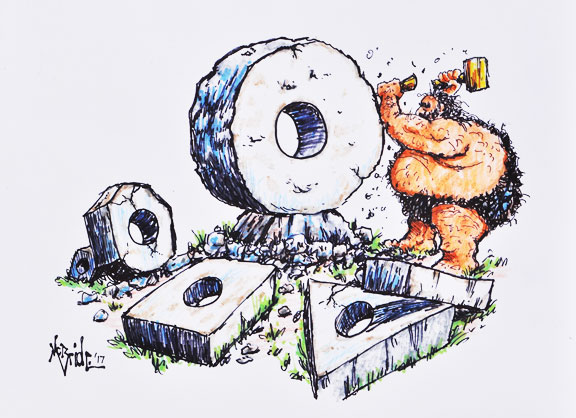
Entrepreneurs Reinvent the Wheel

Entrepreneurs Reinvent the Wheel

Published in the Independence Daily Reporter, March 1, 2017.

We’ve all heard it “There’s no need to reinvent the wheel,” It makes me cringe as much as fingernails on a chalk board. A statement like that indicates a desire to find someone else’s solution and call it good enough. Entrepreneurs almost never leave well enough alone.

Reinventing the wheel doesn’t necessarily mean creating a wheel like no other, ever. Most of the time, reinventing the wheel means making continuous improvement to existing wheels. To reinvent something requires that it was an original invention at some point. Many times, original inventions are a result of mistakes or accidents. We don’t really know much about the caveman (or woman) that invented the first wheel. Maybe it was a joint effort. Could be that in moving a big rock from point A to point B, someone discovered that when pushed on a round stick, the pushing got easier. Through continuous improvement, the big rock eventually was suspended by two big sticks with round rocks on the end of each; axles and wheels. For eons, wheels have been reinvented and made out of various materials. Until relatively recently, the rides from all various materials have been bone-jarring. Finally, we discovered rubber and developed the inflated tires on our wheels today. We can all be thankful that so many people over so many years didn’t say “There’s no need to reinvent the wheel.”

What we’re really talking about here is the need for continuous innovation and constant improvement. In today’s competitive world, if you leave well enough alone, someone will likely reinvent your wheel and leave you in the dust. When you get a good thing going, you had better keep improving it and always be developing the next big thing.

As a teenager in the 1970’s growing up in western Kansas, I remember seeing the TV commercials for the Dixon Zero-Turn lawn mower. Revolutionary; it turned on a dime, allowing very close mowing around tress and other obstacles. Mowing time was cut in half. When I moved to southeast Kansas in 2000, I discovered that Dixon mowers were made in Coffeyville. I toured the plant once in about 2003 and saw mower bodies stacked to the ceiling. It had been a slow year. For thirty years, Dixon was king of the zero-turn mower market, especially for residential mowers. Then something happen, perhaps a patent ran out. Overnight, new zero-turn mowers flooded the market from manufacturers everywhere. Dixon, apparently, was caught with no new innovations. In the next couple of years, after layoffs, the Coffeyville plant closed and what was left of production moved to a new owner’s location. Dixon mowers are still made, but long ago lost their dominance in the marketplace. Maybe there could have been a different outcome had the company recognized the need for continuous innovation.

We all need to be like the entrepreneur who can’t leave well enough alone whether we own a small business or work for others. The businesses, organizations and government offices that don’t recognize the need for continuous innovation run the risk of being deemed obsolete by a demanding marketplace for which “good enough” is no longer good enough.

Jim Correll is the director at Fab Lab ICC at Independence Community College. He can be reached at (620) 252-5349 or by email at jcorrell@indycc.edu.